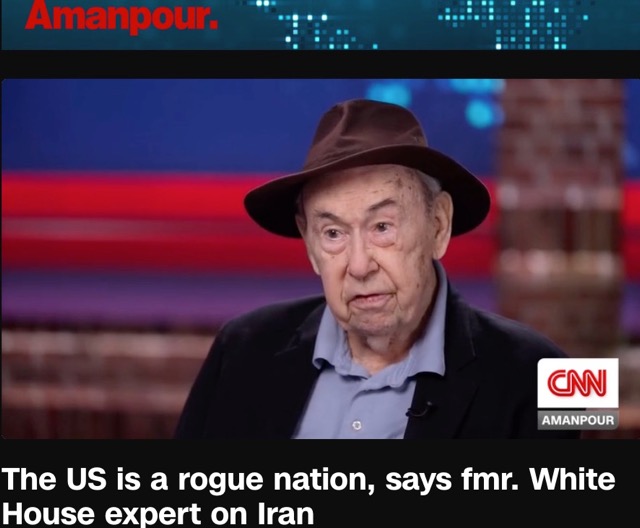
A former White House Iran advisor went on CNN last week and called America a rogue nation. Gary Sick — who served on the National Security Council under three presidents and was the principal White House aide during the 1979 hostage crisis — told Christiane Amanpour that Trump’s military campaign against Iran is impulsive, counterproductive, and destined to make everything worse. The Obama-era nuclear deal, he said, “got it just about right.” Assassination is not an answer. The experts know better.
It’s worth pausing on that claim, because Sick himself provides the best reason to doubt it.
The Track Record
Sick has spent 40 years thinking about what he got wrong on Iran. He says so in the interview. He calls the failure to anticipate the 1979 revolution “one of the greatest intelligence failures in US history,” and traces it to a single structural error: the US trusted the Shah too much and treated Iran as a client state rather than a sovereign nation. Fair enough. But notice what follows from this admission: the man now telling us he knows what works has built his expertise on a foundation of catastrophic misjudgment — and the four decades of policy that flowed from that expertise have not produced anything resembling success.
The diplomatic consensus on Iran since 1979 has been remarkably consistent: be predictable, lead with diplomacy, use sanctions as leverage toward negotiation, avoid provocation, and trust that patient engagement will eventually moderate the regime. Carter tried it. Reagan (after Iran-Contra) tried it. Clinton tried it. Obama tried it most ambitiously with the JCPOA. The result, after 40-plus years of this approach, is a regime that funds Hezbollah, Hamas, and the Houthis; that supplied IEDs that killed hundreds of American soldiers in Iraq; that plotted an assassination on US soil; that crushed the Green Movement and the Mahsa Amini protests; and that has steadily advanced toward nuclear capability.
If this is what expertise produces, the word needs a better definition.
The Unfalsifiable Paradigm
Defenders of the diplomatic approach have a ready answer: real diplomacy hasn’t been tried. The JCPOA was working until Trump withdrew in 2018. Given time, engagement would have strengthened Iranian moderates and gradually opened the regime.
This is the foreign policy equivalent of “real communism has never been tried.” Every failure gets attributed to insufficient commitment rather than a flaw in the method. But the JCPOA was not some tentative half-measure. It was the culmination of decades of diplomatic theory, backed by a multilateral coalition, with concrete sanctions relief and intrusive inspections. And during the period it was in force, Iran continued funding proxy wars across the region, accelerated its ballistic missile program (which the deal conveniently excluded), and maintained “Death to America” as official state rhetoric. If that’s “just about right,” the bar is underground.
The deeper problem is that the establishment has elevated a preference — predictability, patience, diplomatic engagement — to the status of an axiom. When someone violates that axiom, the experts don’t evaluate the results. They declare it reckless by definition, because it departs from the model. This is what Michael Oakeshott called rationalism in politics: an abstract commitment to a method, detached from any empirical feedback about whether the method is actually working.
The Dimension the Experts Can’t See
There is a more fundamental reason to question whether the diplomatic model applies to Iran, and it’s the one most commentators are afraid to raise.
The entire Western diplomatic framework assumes rational-actor behavior. Game theory, deterrence, negotiation — all of it presumes that both parties ultimately prefer survival, prosperity, and political continuity to destruction. Diplomacy works when both sides want a deal more than they want a fight.
But what if one side’s leadership operates, even partly, from an eschatological framework? In Twelver Shia Islam, the return of the hidden imam — the Mahdi (مهدوی) — ushers in a final era of justice. The question is not whether all Iranian leaders are apocalyptic true believers. Obviously they aren’t; the IRGC is also a massive economic conglomerate with thoroughly worldly interests. The question is whether enough of the senior leadership holds genuine eschatological convictions to distort the regime’s strategic calculations in ways that Western diplomatic models cannot account for.
If even a faction of the top leadership believes it has a cosmic mandate — that deception in service of the faith is permissible, that martyrdom is victory, that this world is preparatory for the next — then the entire toolkit of engagement, incentives, and deterrence is miscalibrated. You cannot deter an adversary who does not fear destruction in the way your models assume. You cannot negotiate in good faith with a counterparty whose theology may permit dissimulation as statecraft.
The establishment cannot engage with this possibility because the post-Enlightenment diplomatic tradition treats religious motivation as either a mask for material interests or an aberration that modernization will cure. Sick’s framework has no room for the possibility that the mullahs mean what they say. Taking them at their word would invalidate his entire paradigm.
The Only Scorecard That Matters
Ultimately, the Iran question reduces to one variable: nuclear weapons. Everything else — civilian casualties, oil prices, diplomatic relationships — is secondary to whether Iran acquires a bomb. A nuclear Iran restructures the entire Middle East overnight. Saudi Arabia pursues its own weapon. Turkey recalculates. The NPT is effectively dead in the region.
Both sides claim the nuclear argument. Sick says the JCPOA had Iran at twelve-plus months of breakout time with inspectors on the ground, and we voluntarily surrendered that. The hawks say the deal’s sunset clauses meant Iran would reach threshold capability legally by the early 2030s — the JCPOA didn’t prevent a nuclear Iran, it scheduled one.
The honest answer is that we won’t know who’s right for years. And that uncertainty is itself the point. Sick speaks with the confidence of a man who has been wrong about Iran for four decades. A little more humility — from all sides — would be appropriate.
The Audience Beyond Iran
There is one more dimension the Iran-focused experts consistently underweight: every world capital is watching. The US-Iran conflict is a proxy test of whether America is still willing and able to use decisive force in the post-Iraq, post-Afghanistan era.
If the intervention produces regime change or meaningful strategic concessions, the signal to Beijing regarding Taiwan is sobering. The signal to Moscow regarding further adventurism is sobering. American hard power, which many had written off, is re-credentialed.
If it muddles into quagmire, the signal is catastrophic — the US couldn’t achieve its objectives against a mid-tier power with no nuclear weapons and no great-power patron willing to intervene directly. That may be worse than never having tried, because it reveals the ceiling of American power rather than leaving it ambiguous.
China and Russia have been conspicuously quiet. Are they deterred? Or are they content to watch the US exhaust itself while they consolidate in their own spheres? The answer to that question matters far more than anything Gary Sick thinks about the JCPOA.
The Burden of Proof Has Shifted
Sick makes one genuinely important point in the interview: that ordinary Iranians have historically been among the most pro-American populations in the Middle East, and that decades of misguided policy have steadily eroded that goodwill. He’s probably right. But he draws exactly the wrong conclusion from it.
If the Iranian people are fundamentally cosmopolitan and pro-Western — trapped under a theocracy they didn’t choose and increasingly don’t support — then the case for disrupting that theocracy is stronger, not weaker. Patient diplomacy hasn’t liberated them. Sanctions haven’t liberated them. They rose up in 2009 and 2022 on their own and were crushed both times. At some point, hoping the regime will moderate itself is not patience. It’s abandonment.
I don’t know whether the current military campaign will work. Nobody does. That’s the honest position, and it’s the one neither Sick nor the most hawkish voices will adopt because certainty is the currency of punditry.
But I do know this: the experts keep telling us what can’t work. They’ve had 40 years to show us what can. Gary Sick has spent a career studying what he got wrong about Iran. He still hasn’t considered the possibility that his method — not just his conclusions — might be the problem.
At some point, the burden of proof shifts. Maybe it already has.
This essay is part of an ongoing series on geopolitics and technology at the intersection of identity, strategy, and long-term trends. It does not constitute investment advice.